Why does buying the good coffee or taking the slow morning come wrapped in a little pang of guilt? Here’s a gentler way to think about small luxuries, and how to actually enjoy them.
The other week I bought myself a small bunch of flowers. Nothing extravagant, the kind that sits by the till hoping to be picked. And walking home, I caught myself half-composing a justification, as if I’d need to explain to someone why I’d spent a few dollars on something purely because it would make my kitchen table nicer to sit at. No one had asked. The someone was me.
That reflex is so common it’s almost invisible. We treat ourselves to a small luxury and immediately tax the joy with a little guilt, a quiet sense that we should have been more sensible, more productive, more deserving first. So let’s talk about that, because the guilt is stealing something from you that the flowers were trying to give.
I put the flowers in a glass on the table anyway, and for the next four days I noticed them every single time I sat down. Four days of small, quiet lift for the price of a sandwich. And I kept thinking about how close I’d come to talking myself out of it, and how many other tiny good things I’d probably talked myself out of over the years without even registering the loss. That little bunch of flowers ended up teaching me something I’m still unlearning: that joy doesn’t have to be justified to be allowed.
Where the Guilt Comes From
Most of us absorbed, somewhere along the way, the idea that pleasure has to be earned. That rest and treats are rewards you unlock after being sufficiently productive, and taking them “too early” is a kind of cheating. Layer on a culture that quietly equates busyness with worth, and you get a reflexive guilt any time you choose ease or delight for its own sake.
But here’s the thing worth questioning: you don’t actually have to earn the right to a nice moment. Small pleasures aren’t wages for good behavior. They’re just part of a life that feels like living.
You don’t have to earn the right to a nice moment. Pleasure isn’t a wage for good behavior.
Why the Guilt Actually Backfires
Here’s the quietly ironic part. The guilt doesn’t make you more responsible or more productive. It just taxes the joy so you get less of the very restoration the small pleasure was offering. A coffee drunk with a side of “I shouldn’t be doing this” doesn’t refill you the way the same coffee, fully enjoyed, would. So you end up paying the small cost of the treat without receiving its full benefit, which is the worst of both worlds. Enjoying something completely isn’t the indulgent option. It’s the efficient one, if you want to be unromantic about it.
There’s also a slow erosion that comes from always deferring. If pleasure is forever something you’ll allow yourself once things calm down, once the list is clear, once you’ve earned it, it quietly never arrives, because the list is never clear. Life becomes all deferral and no delight. The small luxury, taken now, on an ordinary unearned Tuesday, is a gentle rebellion against that.
Small Luxuries Aren’t About Money
When I say luxury, I don’t mean expensive. The best small luxuries often cost little or nothing at all. They’re about attention and permission more than price:
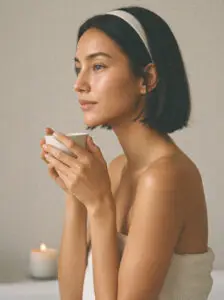
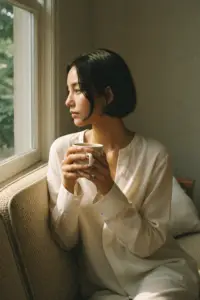
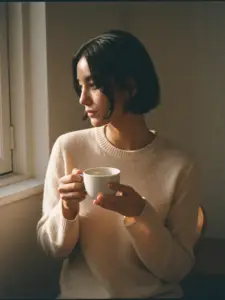
- The good coffee, made slowly, drunk sitting down instead of gulped standing up.
- Fresh sheets on a weeknight, not saved for some special occasion that never comes.
- The long, unhurried shower. The extra ten minutes with your book.
- A single flower stem in a glass. The nicer soap, used on an ordinary Tuesday.
- Saying yes to the slow morning instead of leaping straight into productivity.
These are tiny. That’s the point. A life is mostly made of ordinary days, so learning to place small pleasures inside ordinary days is really learning to enjoy your actual life.
We tend to save our nice things for special occasions, the good china, the fancy candle, the silk slip, and then the special occasion never quite comes and the nice things gather dust in a drawer. There’s a quiet sadness in that. Using the good soap on an ordinary Tuesday isn’t wasteful. It’s a refusal to postpone your own life until some imagined worthier day. Ordinary days are the ones you actually have. They deserve the good soap.
How to Enjoy Them Without the Guilt Tax
The guilt is a habit, and like any habit it loosens with practice. It won’t vanish overnight, and that’s fine; you’re gently retraining a reflex you’ve had for years. A few things that helped me:
Reframe it as care, not indulgence
A small luxury isn’t you being frivolous. It’s you tending to yourself, the same way you’d happily do something kind for a friend. You’re allowed to be that friend to yourself. This is simply the softer hand of real self-care.
Actually savor it
Guilt pulls you out of the moment; savoring pulls you back in. When you take the small luxury, be there for it. Notice the warmth of the cup, the smell of the flowers, the quiet of the slow morning. A pleasure you rush past barely registers. A pleasure you’re present for genuinely refills you.
Make a few of them regular
Build one or two small luxuries into your ordinary rhythm so they stop feeling like something you have to justify. A weekly home spa hour, the good coffee every morning, fresh flowers on the same day each week. When a pleasure becomes a gentle ritual, the guilt quietly falls away.
There’s a lovely side effect to making them regular: anticipation. Knowing the flowers come on Friday, or the slow morning is Sunday, gives you a small warm thing to look forward to all week. The pleasure quietly doubles, once in the waiting and once in the having, and neither half asks you to have earned it.
When a Treat Isn’t Actually Kind to You
One honest caveat, because I don’t want this to read as “buy whatever you want, always.” There’s a difference between a small luxury that genuinely nourishes you and a purchase you reach for to numb a feeling you’d rather not sit with. The flowers, the good coffee, the slow morning, these tend to leave you fuller. Compulsive spending or using treats to avoid something usually leaves a different residue, a hollow feeling underneath. A useful, gentle test: does this leave me feeling cared for, or just briefly distracted? Real small luxuries pass that test easily, and they rarely need to be expensive to do it.
A Few Questions About Small Luxuries
Isn’t this just an excuse to overspend?
It’s really the opposite, since the whole point is that the best small luxuries cost little or nothing. Attention, not money, is the currency here: a slow morning, the good soap you already own, a stem of flowers. If anything, learning to find pleasure in tiny, inexpensive moments tends to loosen the grip of “retail therapy,” because you stop needing a big purchase to feel treated.
How is this different from just being self-indulgent?
Self-indulgence tends to be mindless and often leaves you feeling worse; a savored small luxury is mindful and leaves you feeling cared for. The difference is presence. One is escaping your life, the other is being tenderly present in it. That’s why savoring matters so much, it’s the thing that keeps a small pleasure on the right side of that line.
What if I genuinely can’t afford any extras right now?
Then lean entirely on the free ones, and there are more than you’d think. Sunlight through a window with your morning drink. The first ten minutes of a book. Fresh air on a short walk. A phone call with someone easy. The guilt-free permission this piece is really about costs nothing at all, and it’s the part that matters most.
Permission, Freely Given
So consider this your small, unsolicited permission slip: you’re allowed to have nice things and nice moments, not because you earned them, but because you’re a person, and pleasure is part of a life well lived. That’s the whole spirit of JUNE, really. The little rituals, the small luxuries, the tiny daily acts of choosing to be good to yourself. They add up to a life that glows a little warmer from the inside.
Small luxuries, no guilt
- You don’t have to earn the right to a nice moment.
- Luxury isn’t about money — it’s attention and permission.
- Reframe treats as self-care, not indulgence.
- Savor them fully; guilt only steals the joy.
- Make a few regular, so they stop needing justification.
This week, take one small luxury on an ordinary day, and let yourself enjoy it completely, no justification required. Notice how a tiny bit of freely given permission changes the whole moment.